
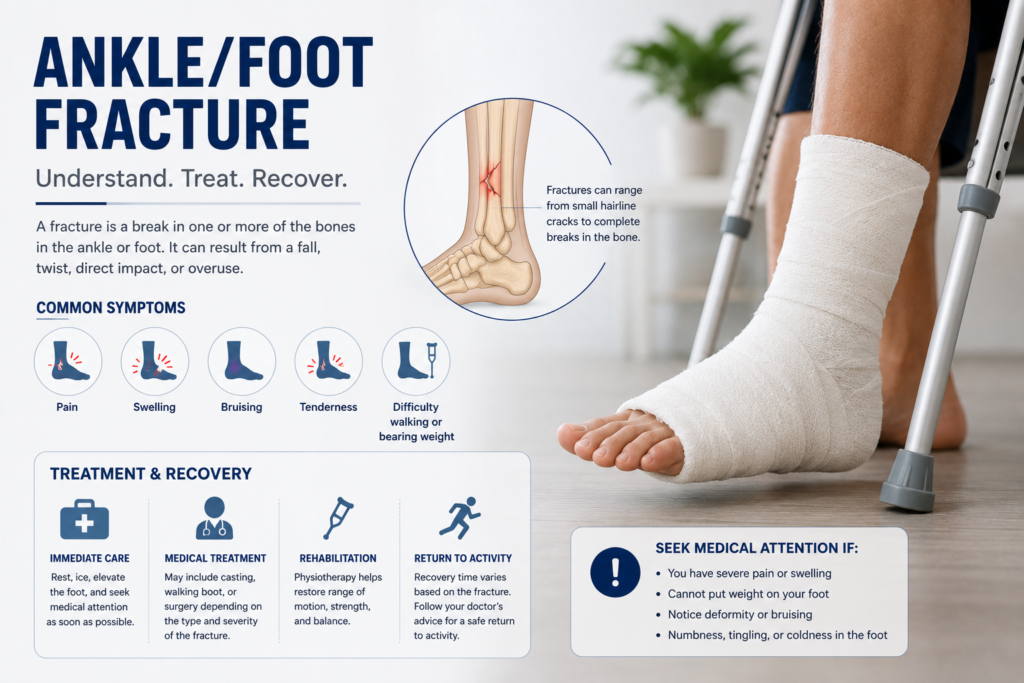
Ankle/Foot Fracture
A fracture is an interruption of the continuity of bone. Ankle fractures almost always occur following a traumatic event. Automobile accidents, falls, sports injuries and even a sprain can all lead to ankle fractures. Common signs of an ankle fracture include pain, swelling, bruising, and an inability to bear weight on the broken ankle even for a few steps.
Why Rehab?
Wolff’s law states that bone grows and remodels in response to the stress that is placed upon it. Therefore, applying the right stress in the correct direction can help to ensure that maximal bone healing occurs and that your fractured ankle will function properly.
Recovery Time
Most patients with an ankle or foot fracture require 6 weeks of immobilisation depending on the fracture type/severity. Patients with an initially non-displaced fracture or who were treated surgically will generally require 4 weeks of non-weight bearing in a short-leg cast or removable walking boot, followed by 2 weeks in a walking cast or boot.
Treatment Approach
Soft tissue manipulation to reduce the chances of heterotopic ossification which is the process whereby bone tissue forms outside the skeleton.
Joint mobilization for adjacent joints such as toe and knee joint can help to maintain range of movement and prevent joint stiffness.
Rigid tape helps to improve ankle dorsiflexion when patient weight bearing.
Aircast walking boot is used to immobilise the fracture, and to allow injured soft tissues to heal in the shortened position rather than a stretched position.
Post surgery gait training with crutches.
- Electrotherapy and also exercise therapy aimed to prevent muscle wasting by strengthening lower limb muscles.
Make An Appointment with us today !
Redefined Physio Kuala Lumpur (KL)
- Level 25.1 Menara AIA Sentral, No. 30, Jalan Sultan Ismail, 50250 Kuala Lumpur.
- +6012-841 2623
- redefinedphysio23@gmail.com
Redefined Physio Petaling Jaya (PJ)
- R-G-01T, Pusat Perdagangan Dataran Atwater, Jalan Professor Diraja Ungku Aziz, Seksyen 13, 46200 Petaling Jaya, Selangor
- +6012-389 2623
- redefinedpj@gmail.com