
ACL Rehab (Post ACL Surgery)
There can be a lot to think about as a physiotherapist guiding your patient through Anterior Cruciate Ligament Reconstruction (ACLR) rehabilitation. Making sure we’re balancing their exercise program to achieve each early-stage goal can be challenging; there is a lot to cover, but we don’t want to overload our patient with an unnecessary amount of exercises!
Why Rehab?
There are still a lot of unknowns and things to improve in the management of ACL tears, but with everything we know today, we can confidently state that a conservative approach should become the gold standard.
Recovery Time
Is bracing necessary? What about weight-bearing? The only thing we can say for sure is that the ACL is less likely to heal if there’s no early protocol, highlighting the importance of starting rehab in the first week and definitely not later than three weeks.
Treatment Approach
Gait Training
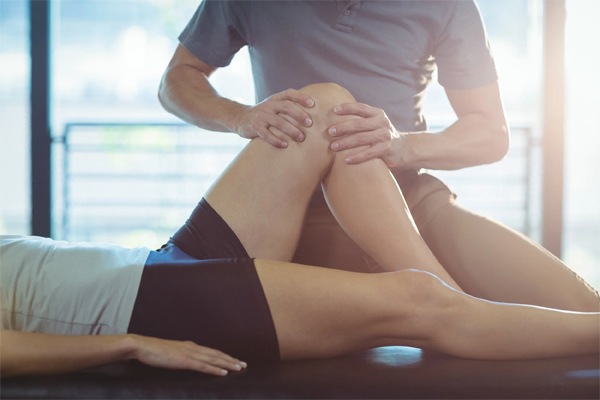
Patellar mobilization
Lunge & step down exercise
Normalising gait
Good walking gait requires adequate knee extension and quad control. Common gait abnormalities seen following ACLR are: walking with bent knee/’fixed flexion’, overusing the calf, avoiding terminal extension, reduced push off, and reduced weight-bearing time on the affected side. Working on gait-specific training from the get-go is important; we want to see controlled extension in mid-to-late stance, allowing adequate push off, and have good quad control throughout the gait cycle.
Patellar mobilization to improve knee range of motion.
– Grip and Glide: Use the web space of your hand to gently grip the edges of the kneecap.
– For Side-to-Side Movement: Apply gentle pressure to glide the patella from the lateral (outer) border to the medial (inner) border and back again.
– For Up-and-Down Movement: Apply gentle pressure to glide the patella from the superior (upper) border downwards and the inferior (lower) border upwards.
Quads, quads and more quads loading
Quad control is a vital part of early-stage rehab. We need those quads firing to have that extension control in activities such as walking, single-leg stance, squatting and running.
They will often compensate by avoiding bending through the operated knee and taking the load through the glutes. Leg extensions have historically been avoided by physios on the basis of graft protection, however a recent systematic review shows that open kinetic chain exercises (when prescribed after six weeks in reduced ROM) did not increase ACL laxity, and leg extensions are a safe and effective way to gain quad strength in early stage ACLR rehab.
Lunge and step down exercises
Because CKC exercises involve the feet being fixed, the combined forces from muscle co-contraction create higher compressive forces in the knee joint, which helps in turn reduce the anterior shear force on the tibia. , a key factor in ACL graft healing.
Lateral hip:
Lateral hip strengthening can be an important part of reducing the risk of patellofemoral pain when returning to activities. Try to make lateral hip exercises as functional (and relevant to running) as possible; this could include banded lateral and zig-zag walks; progress by adding external perturbations requiring the patient to maintain pelvic and knee control with external forces.