
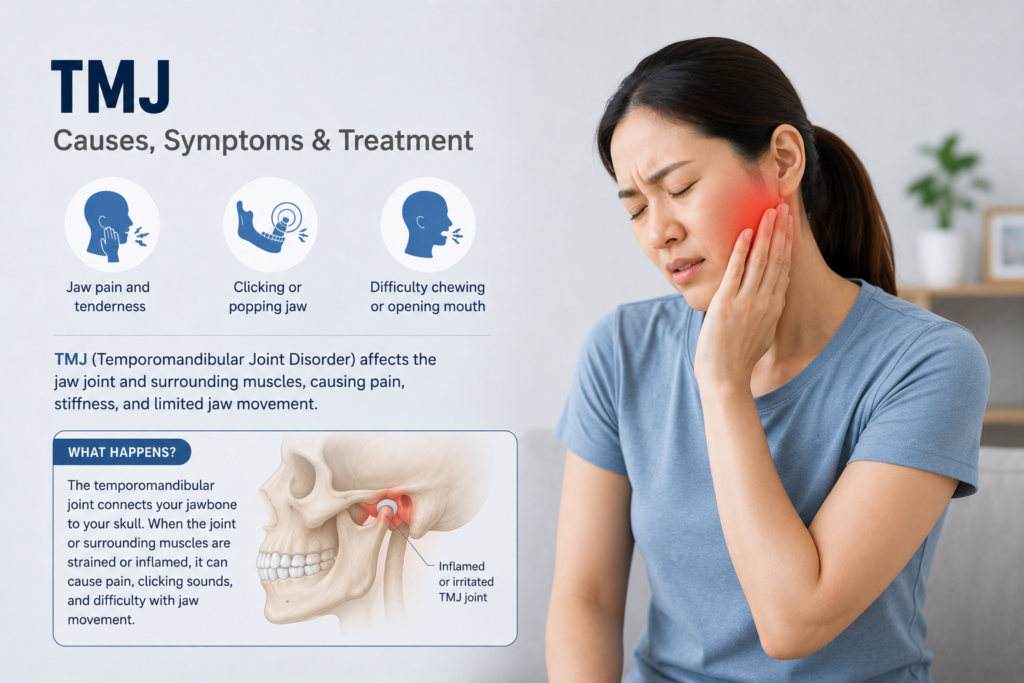
TMJ Assessment
3 Functional tests :
- Mouth opening
– Instruct patient to do active mouth opening and observe if the chin takes initiative in the beginning (+ve for a protrusion of chin) : indicative of TMJ hypo/hyper mobility ; tension of masseter and /or lateral pteryoid muscles.
– Observe for limitation in ROM: +ve if mouth opening less than 3 fingers, 45-48mm. - TMJ mobility
– Palpate condyle/disc complex (anterior to tragus of ear).
– Palpate for asymmetry in the final translatory position of mandible.– If test +ve indicative of TMJ hypomobility , soft tissue hypermobility.
- Hyoid mobility
– Passive lateral to medial direction of hyoid, feel end feel and spring back of the hyoid.
– +ve test: if little or no spring (indicative of ipsilateral digastricus tension).
Treatment Techniques:
1. Treatment for a +ve mouth opening test (to relax lateral pterygoid muscle)
– Hold relax technique: therapist passively opens the patient’s mouth;
Hold: resist patient attempt to poke chin.
Relax: passive chin to posterior direction.
– Lateral pterygoid release:
Contact: intraoral, finger to last molar and as close to TMJ.
Direction: patient actively bite down, when relax, therapist goes to the next barrier.
– Masseter muscle hold relax technique: therapist passively position mouth opening in retrusion; contact lower incisor and patient instructed to gently close the jaw.
Hold: hold against jaw closing; patient inhale and yawn.
Relax: During yawn, bring mandible to next barrier.
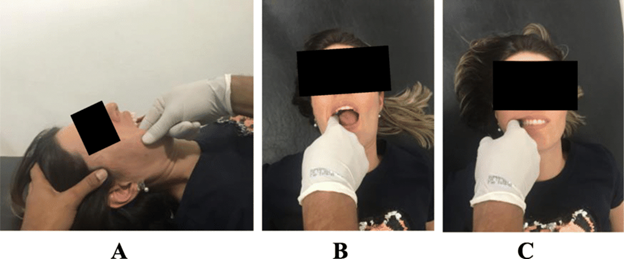
2. Treatment for a +ve Hyoid test
-Hold relax: load hyoid to restriction, position mouth open and chin in retrusion.
Hold: Therapist attempt to close patient’s mouth as patient resist by trying to open.
Relax: release Hyoid and load to next barrier.
-Hyoid release
Contact: Web space of 1st and 2nd fingers grip on hyoid gently , other hand under neck.
Direction: induce to position of ease then add tension.
-Omohyoid release
Step 1: Contact: hyoid bone with contralateral hand. Mobility: lateral glide away.
Step 2: Contact: as above for hyoid, ipsilateral hand palpate for insertion of omohyoid medial to suprascapular notch. Direction: induce stretch caudally on insertion and lateral glide away hyoid.
3. Treatment for a +ve TMJ mobility test
– Identify side of less translation.
– Contact: contralateral thumb on lower molar of the treatment side; ipsilateral hand palpate TMJ.
– Direction: caudal long axis distraction; clockwise rotation of medial condyle/disc; counterclockwise for lateral.
– TMJ mobilisation with movements (MVMs, Mulligan).
Make An Appointment with us today !
Redefined Physio Kuala Lumpur (KL)
- Level 25.1 Menara AIA Sentral, No. 30, Jalan Sultan Ismail, 50250 Kuala Lumpur.
- +6012-841 2623
- redefinedphysio23@gmail.com

Redefined Physio Petaling Jaya (PJ)
- R-G-01T, Pusat Perdagangan Dataran Atwater, Jalan Professor Diraja Ungku Aziz, Seksyen 13, 46200 Petaling Jaya, Selangor
- +6012-389 2623
- redefinedpj@gmail.com