
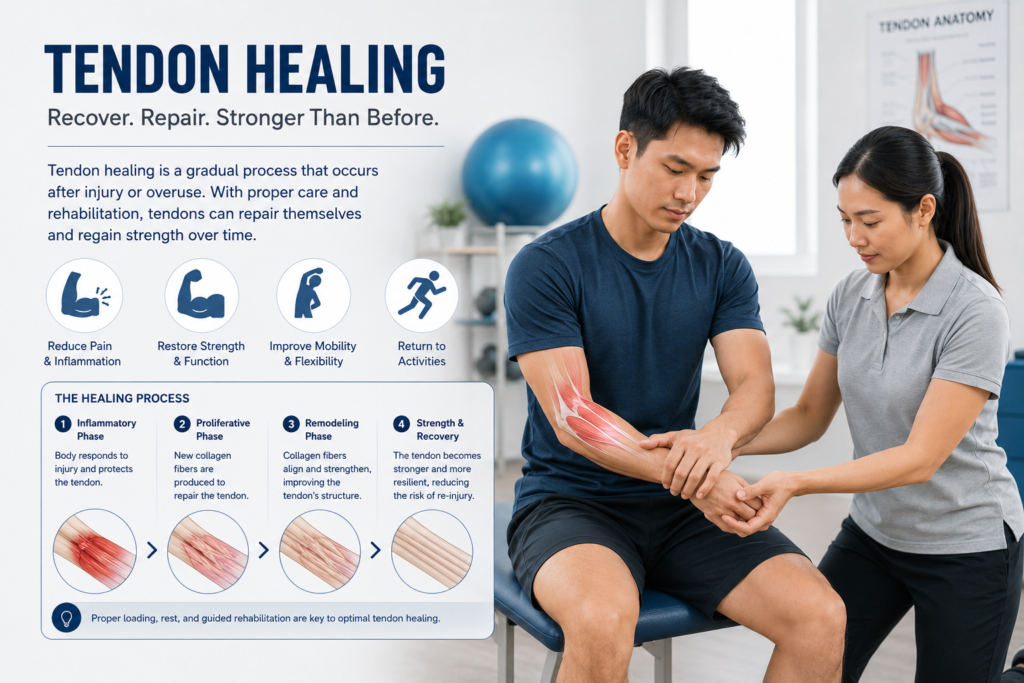
Why Tendons Get Injured—and the Best Way to Help Them Heal
Tendon injuries are among the most frustrating musculoskeletal problems. They often develop slowly, linger for months, and don’t always respond well to rest alone.
How "Jerk" Causes Tendon Injuries
Many tendon injuries are not caused by a single traumatic event. Instead, they develop from repeated, small jerks or sudden changes in force that occur over time.
Tennis Elbow (pain felt outside of the elbow)
We get tennis elbow in the outside of the elbow because we are swinging a tennis racket and our backhand the ball is going the other direction, even that little bit of jerk repeated enough times is going to give us tennis elbow.
Golfer's Elbow (pain felt inside of the elbow)
Similarly, during a golf swing, striking the ground (the turf) before the ball or making poor contact creates an abrupt force traveling through the club into the forearm muscles. These repeated opposing forces can overload the tendons on the inside of the elbow, resulting in golfer’s elbow.
Jumper's Knee (Patellar Tendinopathy)
Sports involving repeated jumping expose the patellar tendon to frequent, high-impact loading. Activities like basketball, volleyball, and even CrossFit exercises involving jerks, Olympic lifts, and explosive movements place significant stress on the tendon. When progressed appropriately, these movements can build resilience and strength. However, excessive or poorly managed loading may contribute to tendon injury.
Tendons Adapt Differently Than Muscles
One important concept is that tendons and muscles do not adapt in exactly the same way. Muscles respond relatively quickly to training by becoming larger and stronger. Tendons adapt more slowly, requiring carefully controlled loading to increase:
- Collagen content
- Mechanical strength
- Load tolerance
The goal is not to use the hardest possible exercise—it is to provide the minimal effective dose that stimulates positive adaptation without causing further damage.
Minimal Effective Dose: Load Enough, But Not Too Much
What Doesn't Heal a Damaged Tendon?
Many people assume that explosive exercises will strengthen an injured tendon. However, movements such as:
- Jumping
- Sprinting
- Plyometrics
- Jerk-based Olympic lifts
are not the primary stimulus for healing a damaged tendon. While these exercises are valuable later in rehabilitation or for athletic performance, they are generally introduced only after the tendon has regained sufficient capacity.
The Role of Isometric Exercises
One of the most effective ways to begin rebuilding an injured tendon is through heavy isometric contractions. Examples include:
- Isometric squats
- Isometric leg press
- Isometric leg extension holds
During an isometric contraction:
- The muscle contracts forcefully without visible joint movement.
- As the contraction is sustained, the muscle slowly shortens.
- The tendon gradually relaxes and lengthens under tension.
This phenomenon is known as stress relaxation (sometimes described alongside stress shielding). This creates a unique mechanical environment that stimulates tendon remodeling while minimizing excessive movement at the injured site.
How Much Load Is Needed?
Research and clinical practice suggest gradually working toward approximately 70% of your maximum voluntary contraction. The focus is on high-quality tension, not excessive repetitions. A practical example:
- Total time under tension: 10 minutes
- Hold each contraction for 30 seconds
- Rest between contractions
Why Hold Instead of Move?
A useful way to think about isometric exercises is: Healthy tissue relaxes; injured tissue works. The sustained hold allows the damaged portion of the tendon to experience controlled loading without the rapid force changes associated with jumping or running. This controlled mechanical stimulus helps direct collagen remodeling and tendon repair.
Stiff Tendons: Good or Bad?
Training changes tendon stiffness. Dynamic, high-force training often produces:
- Larger muscles
- Stiffer tendons
A certain degree of stiffness improves athletic performance by allowing more efficient force transmission. However, excessively stiff tendons may also increase injury risk if they cannot tolerate sudden or repetitive loading.
The goal is not simply to create the stiffest tendon possible, but rather a tendon that is strong, resilient, and capable of handling the demands placed upon it.
Tendons Receive Nutrition Differently
Unlike muscles, tendons, ligaments, and cartilage have relatively poor blood supply. Instead of relying heavily on direct circulation, they obtain many of their nutrients through the movement of the surrounding tissue fluid.
This is one reason why appropriate loading is beneficial. Mechanical loading helps facilitate fluid exchange, supporting tissue nutrition and maintaining tendon health.
Consistency Matters
Many people notice significant pain relief within 1–2 weeks of beginning isometric exercises. However, pain reduction does not necessarily mean the tendon has fully healed. To achieve meaningful structural adaptation, rehabilitation typically requires:
- Daily loading
- Approximately 8 weeks of consistent training
Stopping once the pain improves may leave the tendon underprepared for returning to high-impact activities.
Key Takeaways
- Most tendon injuries develop from repeated, small “jerk” forces rather than a single event.
- Tendons require progressive mechanical loading to become stronger.
- Use the minimal effective dose—enough load to stimulate adaptation without aggravating the injury.
- Heavy isometric exercises are one of the most effective early rehabilitation strategies.
- Gradually build toward approximately 70% of maximum effort during sustained holds.
- Jumping, sprinting, and plyometric exercises are valuable later but are not the primary method for healing an injured tendon.
- Tendons, ligaments, and cartilage rely heavily on surrounding fluid for nutrition, making appropriate movement and loading essential.
- Continue rehabilitation for about 8 weeks, even if symptoms improve much sooner, to allow the tendon adequate time to remodel and strengthen.
Make An Appointment with us today !
Redefined Physio Kuala Lumpur (KL)
- Level 25.1 Menara AIA Sentral, No. 30, Jalan Sultan Ismail, 50250 Kuala Lumpur.
- +6012-841 2623
- redefinedphysio23@gmail.com
Redefined Physio Petaling Jaya (PJ)
- R-G-01T, Pusat Perdagangan Dataran Atwater, Jalan Professor Diraja Ungku Aziz, Seksyen 13, 46200 Petaling Jaya, Selangor
- +6012-389 2623
- redefinedpj@gmail.com